
Capital Markets Review – Q2 2024

Unwavering Focus on Long-Term Goals
During the second quarter the headline return for the S&P 500 edged above 4%, with performance concentrated in the 10 largest companies. The remaining 490 members declined 2.9%. This concentration of performance is now the narrowest on record as the percentage of stocks beating the S&P 500 recently reached a record low.1 This represents the widest divergence in performance in at least 30 years and is a sign of a very unhealthy and potentially dangerous market.2
Breaking the S&P 500 into factors, of the twelve different categories, four were positive and only growth, momentum and quality outperformed. Quality remains our largest equity exposure alongside our overweight to energy. These two equity allocations have achieved double-digit returns through the first half of the year, even though energy declined slightly during the quarter. Additionally, emerging markets outperformed the S&P 500 during Q2. In short, our equity positions have provided solid positive returns thus far in 2024 under very unique market circumstances.
Building Wealth
The financial media spend an inordinate amount of time covering equities, especially those companies (e.g., Nvidia) experiencing the most thrilling trading activity. While this makes for good news stories, owning too many equities at the wrong times or focusing in the riskiest places can nullify years of progress and potentially derail a financial plan. As we observed in 2022, many of today’s strongest performers may represent tomorrow’s underperformers. Therefore, it is essential to allocate capital to areas that offer the best risk-adjusted return potential and not to areas that currently look speculative and overvalued.
The key principles of building and maintaining wealth include an unwavering focus on compounding absolute returns with low volatility and the avoidance of large losses. Compelling returns are present today in short-term treasuries, specific areas of fixed income and select equity exposure. Using these vehicles, we believe we can effectively achieve our goal of multiplying your returns without taking undue risk that is so prevalent in the financial markets today.
Potential Consequences of Narrow Market Performance
In our most recent edition of the Capital Markets Review, we highlighted that concentrated performance has supported the strongest momentum-based rally the S&P 500 has experienced since the tech bubble. The similarities run far deeper than just market performance. As shown in Chart 1, the interest in Artificial Intelligence appears to be even more striking than the advent of the Internet in the late 90’s.
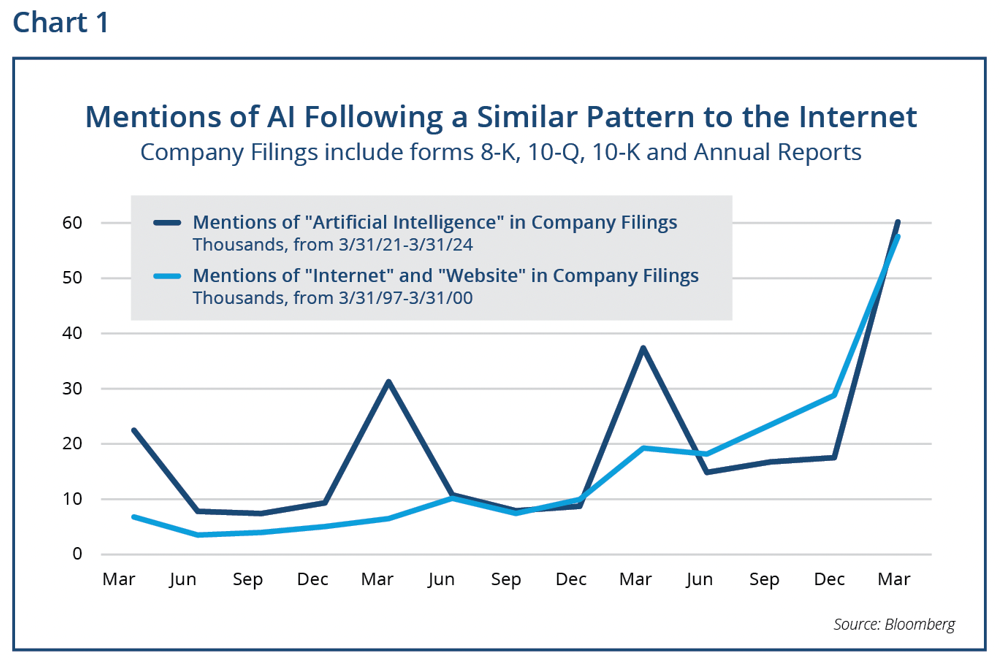
Just as the Internet was real, so too is the AI boom. This holds significant implications for the future much like the major innovative developments of the past such as the introduction of railroads, automobiles, broadcasting, the internet and so many others. Some of the best investment opportunities to gain exposure to the internet over the last two decades were not even public equities during the internet boom: Google and Meta (formerly Facebook). They didn’t emerge as public entities until years after the tech bubble subsided. This suggests that the biggest beneficiaries of AI looking forward may not be known yet.
In the last 50 years alone, we have experienced a number of asset bubbles as depicted in Chart 2. Nvidia’s meteoric rise has now outpaced all of them. At its recent peak, the chipmaker’s market capitalization reached 11% of GDP, more than twice the peak level Cisco reached during the tech bubble.
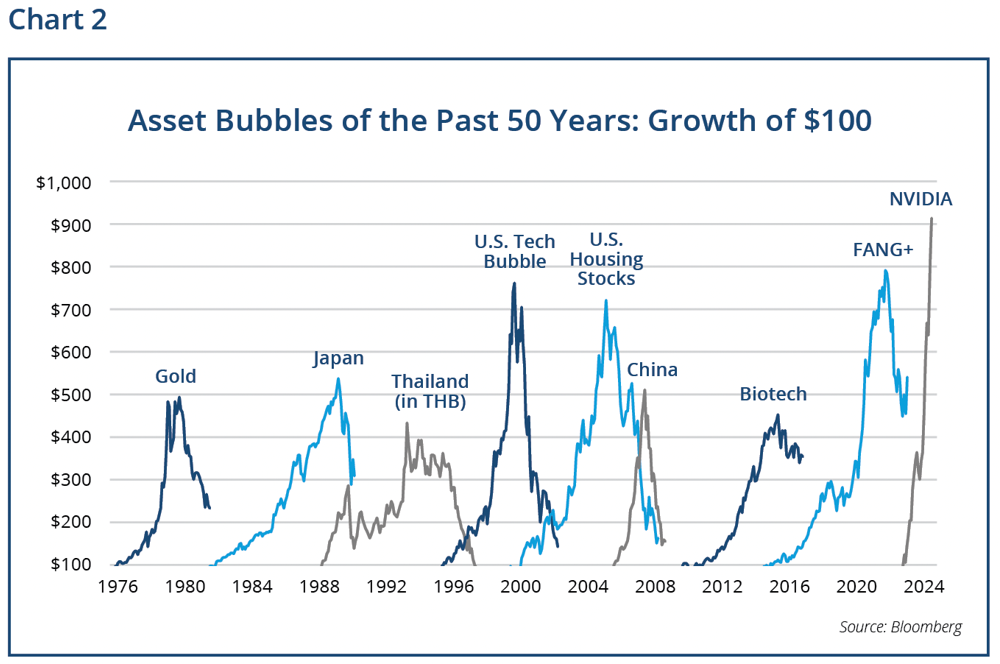
A noteworthy takeaway from Chart 2 indicates that each of the asset bubbles of the last 50 years has ended up falling nearly as fast as their rise. Each one of the past peaks featured a misallocation of capital, driven by unrealistic expectations, coupled with the overconfidence of speculators. Today, the top 10 stocks of the S&P 500 represent over 35% of the index, more than double the weight over the last decade and more concentrated than the tech bubble which peaked below 30%. In fact, the top 3 stocks (Microsoft, Apple and Nvidia) garner more than 20% of the index and their market caps combine for the more than 30% of GDP.
Opportunities in Fixed Income Offer Healthy Compounding
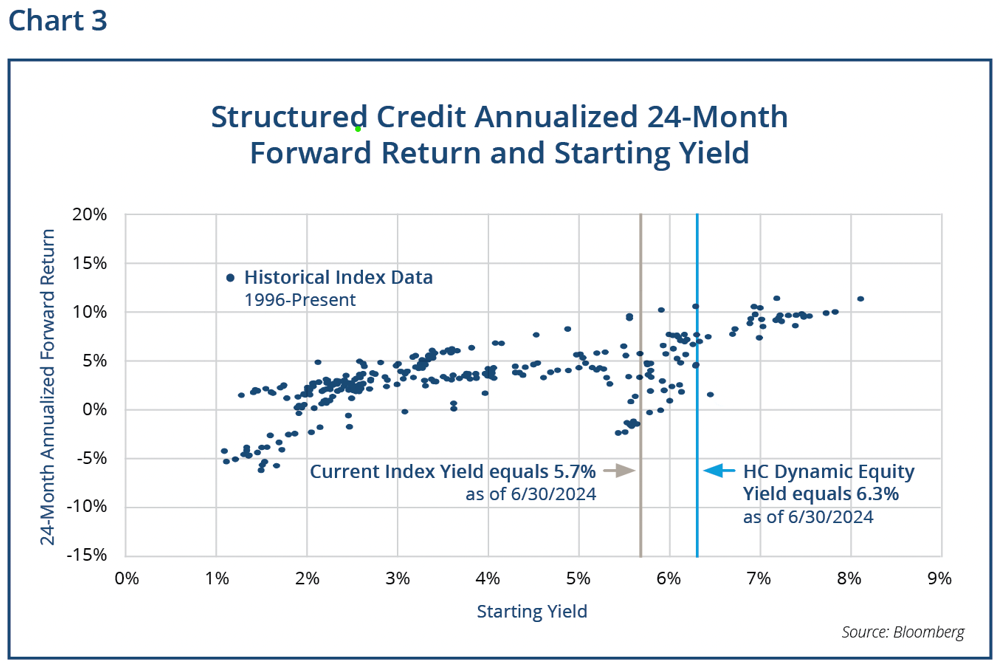
The advantage of our multi-asset portfolios is they can look across the equity, fixed-income and cash equivalent markets in search of high-quality absolute returns with high margins of safety. Given the excesses in the equity markets, we are finding opportunity outside of equities. One such place is structured credit, which includes mortgage-backed and asset-backed securities supported with limited default risk. As displayed on Chart 3, based on our current target weightings within our Dynamic Equity Strategy, structured credit is offering a current yield of 6.3%.
In addition to this attractive yield, should interest rates decline from here, the opportunity to generate low double-digit returns through capital appreciation is a real possibility. As a result, we continue to believe that we can achieve equity-like returns with far less risk by allocating resources here. Over the past year, we have increased our exposure to structured credit and are looking to add more opportunistically.
We are also finding short-term treasuries currently attractive with yields above 5%. The current highly concentrated equity market features very high valuations with asymmetric downside risk. In our opinion, expected returns for equities are likely to be very low to negative with the prospect of higher-than-normal volatility. In this environment the yields available in short-term treasuries and fixed income are quite appealing.
Summary and Outlook
We continue to believe that our dynamic approach to asset allocation will build the high quality compounded annual growth rates you need over time. With interest rates providing an alternate source of return and the presence of unacceptable levels of risk in many equities, we continue to be very selective in these exposures.
Make no mistake, pockets of opportunity in equities are still present and we are taking advantage of them with what we believe is the right sizing in our portfolios. Good examples include our investments in energy stocks, which boast a total shareholder yield (dividends plus buybacks) more than twice that of the S&P 500, and quality stocks, which provide lower volatility while maintaining consistent profitability.
We believe more compelling entry points to add to our positions in equities should emerge over the next year as the long and variable lags of tightening policy continue to flow through the economy. Until then, we are staying with the strategy that has proven to be successful during other periods of market excess.
As always, we are grateful for the privilege of allowing us to guide your assets forward. Should you have any questions or observations, please don’t hesitate to contact us.
1 Ned Davis Research, Chart AA312 (Yearly data 1973-12-31 to 2024-6-28.)
2 “Record-Busting Anomalies May Flash Trouble for Global Stocks”, Gina Martin Adams, Bloomberg.
Download PDF Let’s Start a Conversation